
Introduction
The video conferencing market has experienced significant growth in recent years, driven by the widespread adoption of remote work, digital communication, and globalization of businesses. Video conferencing solutions enable real-time communication through video and audio, allowing organizations to collaborate efficiently regardless of geographical boundaries.
With advancements in cloud computing, artificial intelligence, and high-speed internet connectivity, video conferencing platforms have become more accessible and reliable. These solutions are widely used across corporate enterprises, educational institutions, healthcare organizations, and government sectors.
The increasing demand for seamless communication and collaboration tools is pushing organizations to invest in advanced video conferencing technologies. As hybrid work models continue to gain traction, the market is expected to expand steadily in the coming years.
Video Conferencing Market Size
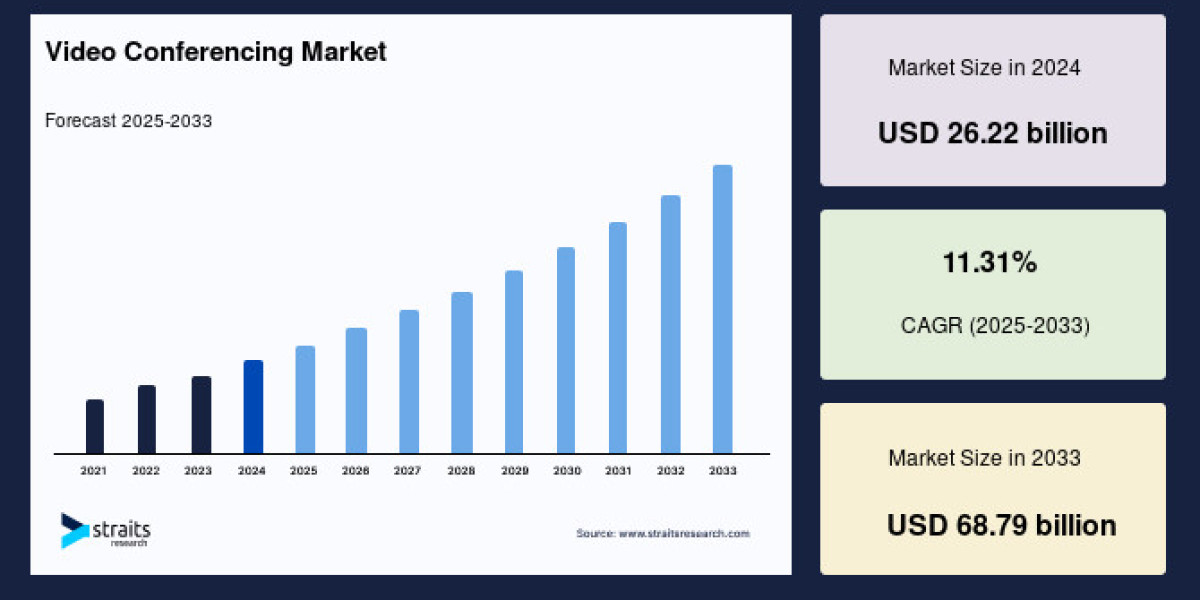
The global video conferencing market size was valued at USD 26.22 billion in 2024.
It is expected to grow from USD 29.19 billion in 2025 to reach USD 68.79 billion by 2033, growing at a CAGR of 11.31% during the forecast period (2025-2033).
Get Full Report Now: https://straitsresearch.com/report/video-conferencing-market
Market Drivers and Challenges
Market Drivers
The growing adoption of remote and hybrid work models is one of the primary drivers of the video conferencing market. Organizations are increasingly relying on digital communication tools to maintain productivity and collaboration.
The expansion of global businesses is also contributing to market growth, as companies require efficient communication platforms to connect teams across different regions.
Technological advancements such as artificial intelligence, real-time transcription, and enhanced video quality are improving user experience and driving adoption.
The rise of online education and e-learning platforms is further boosting demand for video conferencing solutions.
Healthcare sector adoption for telemedicine and virtual consultations is another key growth factor.
Get Your Sample Report Here: https://straitsresearch.com/report/video-conferencing-market/request-sample
Market Challenges
Security and privacy concerns remain significant challenges in the video conferencing market, as organizations handle sensitive data during virtual meetings.
Bandwidth limitations and connectivity issues can affect the quality of video conferencing sessions, particularly in remote areas.
High implementation costs for advanced systems may restrict adoption among small businesses.
Integration challenges with existing enterprise systems can create operational complexities.
User fatigue and over-reliance on virtual meetings may impact productivity and engagement.
Market Segmentation
By Component
The market is segmented into hardware, software, and services.
Software solutions dominate the market due to the increasing adoption of cloud-based platforms.
Hardware components include cameras, microphones, and display systems used in conferencing setups.
Services include installation, maintenance, and support.
By Deployment Mode
The market is segmented into cloud and on-premises.
Cloud-based deployment is gaining popularity due to its scalability, flexibility, and cost-effectiveness.
On-premises solutions are preferred by organizations requiring higher data security and control.
By Enterprise Size
The market is segmented into small and medium enterprises and large enterprises.
Large enterprises dominate the market due to higher investment capacity and global operations.
Small and medium enterprises are increasingly adopting cloud-based video conferencing solutions.
By End User
The market is segmented into corporate, education, healthcare, government, and others.
The corporate sector holds the largest share due to extensive use for meetings and collaboration.
Education sector uses video conferencing for virtual classrooms and remote learning.
Healthcare sector utilizes these platforms for telemedicine services.
Government organizations use video conferencing for administrative and communication purposes.
By Region
The market is segmented into North America, Europe, Asia-Pacific, Latin America, and the Middle East and Africa.
North America leads the market due to advanced technological infrastructure and early adoption.
Europe is driven by digital transformation initiatives.
Asia-Pacific is witnessing rapid growth due to increasing internet penetration and business expansion.
Latin America and the Middle East and Africa are emerging markets with growing adoption of communication technologies.
Top Players Analysis
Zoom Video Communications Inc.
Zoom is a leading provider of video conferencing solutions, known for its user-friendly interface and scalable cloud platform.Microsoft Corporation
Microsoft offers video conferencing solutions through its unified communication platforms, enabling seamless collaboration.Cisco Systems Inc.
Cisco provides enterprise-grade video conferencing solutions with advanced security and networking capabilities.Google LLC
Google delivers video conferencing services integrated with its productivity tools and cloud ecosystem.Adobe Inc.
Adobe offers web conferencing solutions designed for virtual meetings, webinars, and online training.LogMeIn Inc.
LogMeIn provides remote connectivity and video conferencing solutions for businesses.BlueJeans Network
BlueJeans delivers cloud-based video conferencing services with high-quality audio and video.Poly (Plantronics, Inc.)
Poly offers communication hardware and software solutions for video conferencing.Huawei Technologies Co., Ltd.
Huawei provides advanced video conferencing solutions with strong network integration.Avaya Inc.
Avaya offers unified communication solutions, including video conferencing for enterprise users.
Conclusion
The video conferencing market is set to witness robust growth driven by the increasing demand for digital communication and collaboration tools. The rise of remote work, advancements in technology, and expansion of global businesses are key factors supporting market expansion.
Despite challenges such as security concerns and connectivity issues, continuous innovation and adoption of cloud-based solutions are expected to drive the market forward. Video conferencing will remain a critical component of modern communication strategies across industries.
FAQs
What is video conferencing?
Video conferencing is a technology that enables real-time communication through video and audio between individuals or groups in different locations.
What drives the video conferencing market?
Key drivers include remote work adoption, digital transformation, and advancements in communication technologies.
Which segment dominates the market?
The software segment dominates due to the increasing use of cloud-based platforms.
What are the challenges in the market?
Challenges include security concerns, connectivity issues, and high implementation costs.
Who are the key players in the market?
Major players include Zoom Video Communications Inc., Microsoft Corporation, Cisco Systems Inc., and Google LLC.
About Us:
Straits Research is a leading research and intelligence organisation, specialising in research, analytics, and advisory services, along with providing business insights & research reports.
Contact Us:
Email: sales@straitsresearch.com
Tel: +1 646 905 0080 (U.S.), +44 203 695 0070 (U.K.)