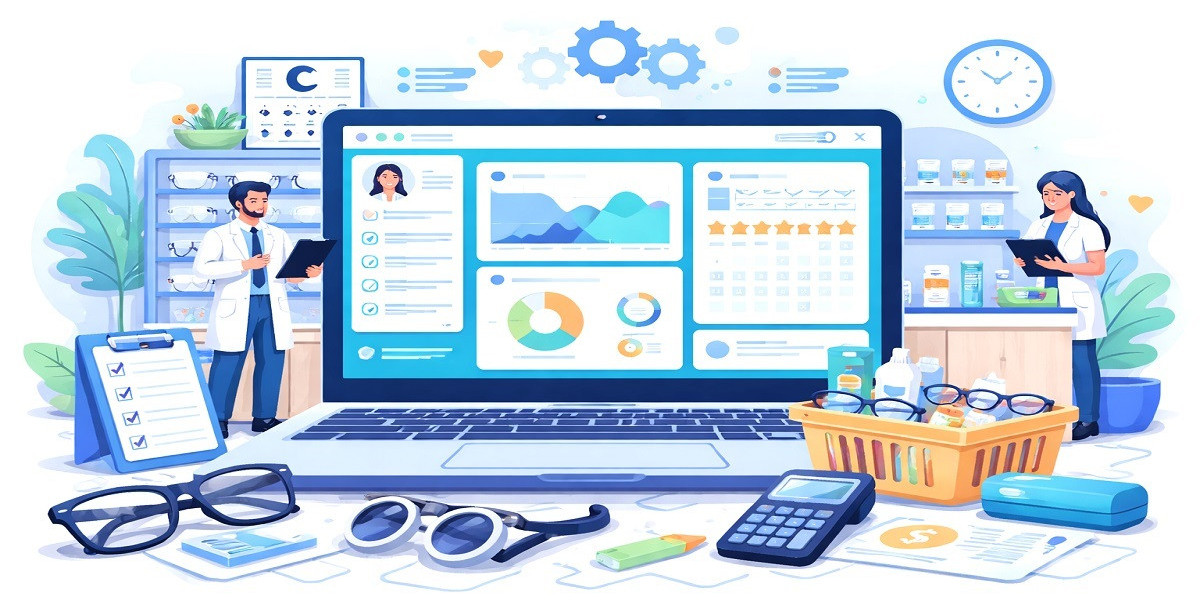

The optical retail industry in Saudi Arabia is evolving rapidly as customer expectations continue to rise. Modern consumers expect fast service, accurate prescriptions, personalized recommendations, and seamless after-sales support. To meet these demands, optical businesses need technology that goes beyond basic record-keeping. برنامج إدارة محلات البصريات has emerged as an advanced solution that helps optical stores automate operations, improve customer experiences, and achieve sustainable business growth in 2026.
Traditional management methods often struggle to handle today's complex retail environment. برنامج إدارة محلات البصريات provides a complete digital platform that integrates inventory management, sales, appointments, prescriptions, customer records, financial reporting, and employee performance into one centralized system. This modern approach helps Saudi optical businesses remain competitive while supporting long-term operational excellence.
The Evolution of Optical Store Management
Optical stores have transformed significantly over the past decade. Earlier, many businesses relied on spreadsheets, manual files, and disconnected software applications. These traditional systems worked for smaller operations but became inefficient as customer bases expanded.
Today's optical retailers require real-time access to information, automated workflows, and integrated business management. Digital transformation has become an essential part of business success rather than an optional investment.
Understanding Traditional Optical Management Systems
Traditional systems typically focus on limited administrative tasks. They often require employees to perform repetitive manual work, increasing the chances of human error.
Business owners usually face challenges in tracking inventory accurately, managing customer histories, processing prescriptions efficiently, and generating financial reports. These limitations reduce productivity and slow overall business performance.
Why Saudi Arabia Is Moving Toward Digital Optical Solutions
Saudi Arabia's Vision 2030 encourages businesses across various sectors to embrace digital transformation. Healthcare and retail industries are investing heavily in technology to improve customer satisfaction and operational efficiency.
Optical stores are following this trend by implementing intelligent software solutions that simplify daily operations while meeting evolving regulatory and customer requirements.
Complete Integration Across Business Operations
One of the biggest differences between modern software and traditional systems is complete integration.
Instead of managing sales, inventory, accounting, appointments, prescriptions, and customer records separately, everything works together within one platform.
Employees spend less time entering duplicate information, while managers gain instant visibility into every department.
Smarter Inventory Management
Inventory is one of the most valuable assets in any optical business.
Traditional inventory management often depends on manual stock counts, which can result in inaccurate records and delayed ordering decisions.
Modern optical management software continuously tracks inventory movement in real time.
Every sale automatically updates stock levels.
Every purchase instantly reflects in inventory records.
Business owners know exactly which frames, lenses, sunglasses, and accessories require replenishment.
This reduces stock shortages while minimizing unnecessary inventory investments.
Better Prescription Management
Prescription accuracy is essential in optical retail.
Traditional filing systems make searching for historical prescriptions difficult and time-consuming.
Modern systems securely store complete prescription histories for every customer.
Employees can quickly retrieve previous records during follow-up visits.
This improves service quality while reducing administrative workload.
Customers also appreciate the convenience of having their prescription information available whenever needed.
Faster Customer Service Experience
Customers expect quick service without unnecessary waiting.
Traditional systems often require staff to search through paperwork or multiple applications before assisting customers.
Integrated software displays customer information instantly.
Employees can view prescriptions, purchase history, warranty details, previous orders, and contact information from one dashboard.
This significantly shortens service times while creating a more personalized shopping experience.
Intelligent Appointment Scheduling
Appointment management has become increasingly important for optical clinics and retail stores.
Traditional appointment books frequently lead to scheduling conflicts and missed appointments.
Digital scheduling allows staff to organize eye examinations efficiently while reducing booking errors.
Automatic reminders help customers remember appointments, improving attendance rates and reducing lost business opportunities.
Improved Sales Performance
Modern software provides valuable insights into sales activities.
Managers can identify best-selling products, seasonal demand, customer preferences, and sales trends.
Instead of relying on assumptions, decisions become data-driven.
This helps businesses optimize pricing strategies, promotional campaigns, and inventory planning.
Traditional systems rarely offer this level of business intelligence.
Enhanced Customer Relationship Management
Customer loyalty plays a major role in long-term success.
Advanced optical software stores detailed customer profiles that include buying behavior, prescription history, preferred brands, and communication preferences.
Businesses can send personalized promotions, service reminders, warranty notifications, and follow-up messages.
These personalized interactions strengthen customer relationships while encouraging repeat purchases.
Financial Accuracy and Business Control
Financial management becomes much easier when every transaction is automatically recorded.
Sales, returns, supplier payments, customer invoices, and expenses remain synchronized.
Managers can generate financial reports instantly instead of spending hours collecting information from different sources.
Accurate reporting supports better budgeting, forecasting, and strategic planning.
Real-Time Business Analytics
Business owners need accurate information to make informed decisions.
Modern dashboards display key performance indicators in real time.
Managers can monitor revenue, inventory turnover, employee productivity, customer growth, and profit margins without waiting for manual reports.
These insights help businesses respond quickly to changing market conditions.
Employee Productivity Improvements
Automation eliminates repetitive administrative work.
Employees spend less time entering data and more time serving customers.
Workflows become standardized across the organization.
Training new staff also becomes easier because the software provides structured operational processes.
Higher productivity directly contributes to improved customer satisfaction.
Multi-Branch Management Capabilities
Many optical retailers in Saudi Arabia operate multiple branches.
Traditional systems often require separate databases for each location.
Modern software connects all branches within one centralized platform.
Management can monitor inventory, sales performance, customer activity, and employee productivity across every location.
Centralized control supports consistent business operations.
Enhanced Security and Data Protection
Protecting customer information is increasingly important.
Paper records and outdated systems face greater risks of loss, theft, or unauthorized access.
Modern management platforms include user permissions, encrypted databases, regular backups, and secure access controls.
These security features help protect sensitive customer information while supporting regulatory compliance.
Automation Reduces Human Errors
Manual processes naturally increase the possibility of mistakes.
Incorrect inventory entries, duplicated customer records, billing errors, and lost prescriptions affect business performance.
Automation significantly reduces these risks.
Information entered once becomes available throughout the system, eliminating duplicate work and improving overall accuracy.
Better Supplier Management
Managing suppliers becomes easier with integrated procurement tools.
Businesses can track purchase orders, delivery schedules, supplier performance, and outstanding payments from one interface.
This simplifies vendor relationships while ensuring timely stock replenishment.
Better purchasing decisions also improve profitability.
Personalized Marketing Opportunities
Modern software enables targeted marketing campaigns based on customer behavior.
Businesses can identify customers due for eye examinations, prescription updates, or replacement eyewear.
Personalized communication increases customer engagement while generating additional revenue opportunities.
Traditional systems rarely provide this level of marketing intelligence.
Mobile Accessibility for Business Owners
Today's business owners expect access to important information from anywhere.
Cloud-based solutions provide secure access using smartphones, tablets, and laptops.
Managers can review reports, monitor sales, approve transactions, and oversee branch performance even when working remotely.
This flexibility supports faster decision-making.
Scalability for Growing Businesses
As businesses expand, management requirements become more complex.
Traditional software often struggles to support increasing transaction volumes or additional store locations.
Modern optical management platforms are designed for growth.
Businesses can add users, branches, inventory categories, and customer databases without replacing the entire system.
This protects technology investments over the long term.
Compliance with Modern Business Standards
Saudi businesses operate within an evolving regulatory environment.
Digital management systems help maintain organized records, financial documentation, and transaction histories.
Well-structured reporting simplifies audits while supporting compliance with business regulations and tax requirements.
This reduces administrative stress for management teams.
Supporting Better Customer Experiences
Excellent customer experiences drive long-term success.
Customers appreciate fast billing, accurate prescriptions, efficient appointment scheduling, and personalized recommendations.
Integrated software enables employees to deliver consistent service at every customer interaction.
Satisfied customers become loyal customers who recommend the business to family and friends.
Preparing Optical Businesses for the Future
Technology continues to reshape retail healthcare industries worldwide. Artificial intelligence, predictive analytics, automation, and cloud computing are becoming increasingly important. Businesses that invest in advanced management software today position themselves for future innovation.
The gap between traditional management methods and modern digital solutions continues to widen in 2026. While traditional systems may still handle basic administrative work, they lack the automation, intelligence, integration, and scalability required by today's competitive optical market. برنامج إدارة محلات البصريات enables Saudi optical retailers to streamline operations, improve customer satisfaction, strengthen financial management, optimize inventory, and support long-term business growth. By embracing advanced technology, optical businesses can build a more efficient, profitable, and customer-focused future.
FAQs
What is برنامج إدارة محلات البصريات?
It is a comprehensive software solution designed to manage optical store operations, including inventory, prescriptions, sales, appointments, and customer records.
Why is modern optical software better than traditional systems?
It automates business processes, reduces errors, improves efficiency, and provides real-time business insights.
Can the software manage multiple optical branches?
Yes. Most modern solutions allow centralized management of multiple locations through one integrated platform.
Does optical management software improve customer service?
Yes. It provides faster access to customer records, prescription history, appointments, and purchase information for personalized service.
Is optical management software suitable for growing businesses?
Yes. Modern systems are scalable and can easily support expanding inventory, additional branches, and increasing customer volumes.